
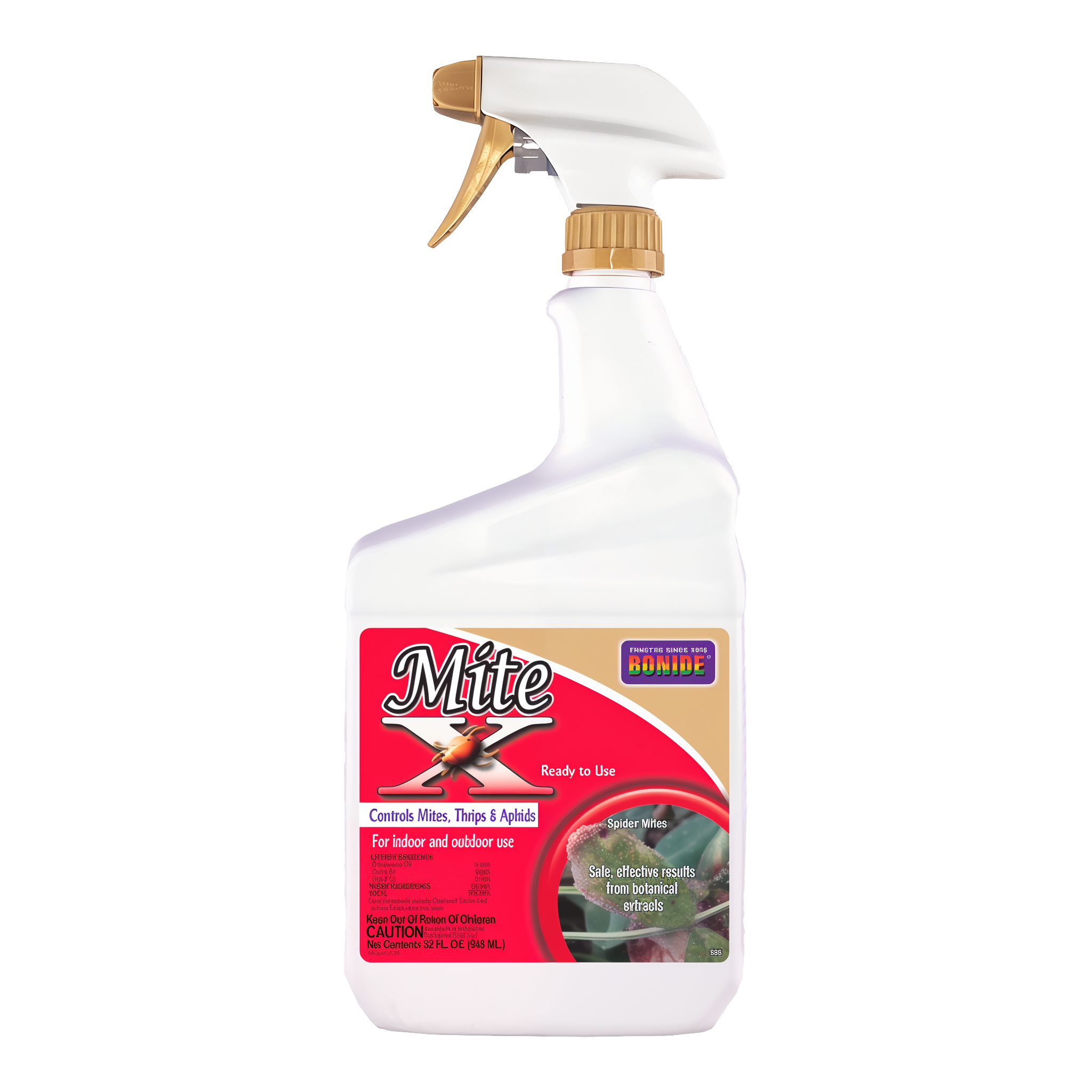

Description
Bonide Mite-X is a 32 fl oz ready-to-use trigger spray for controlling spider mites, broad mites, russet mites, thrips, and aphids on indoor and outdoor plants. Active ingredients are botanical extracts — cottonseed oil, clove oil, and garlic oil — in a low-toxicity carrier of food-grade fatty acids. Kills on contact, dries quickly, and (used correctly) is safe on most ornamentals, vegetables, and houseplants right up to harvest.
Active Ingredients + Mode of Action
- Cottonseed oil 0.40% — primary suffocating / smothering agent for soft-bodied pests
- Clove oil 0.20% — eugenol-based; disrupts the octopamine neuroreceptor in insects (a target absent in mammals, which is why botanical oil sprays have such low mammalian toxicity)
- Garlic oil 0.10% — sulfur-compound repellent + ovicidal activity
- Inert ingredients 99.30%: oleic acid, lauric acid, sodium bicarbonate, water (food-grade fatty acid carrier system)
- Contact action only — this is a knockdown spray, not a systemic. Pests die when sprayed; new pests landing later need to be re-sprayed. No long residual.
- EPA “25(b) minimum risk” class — exempt from full EPA registration because the active ingredients are on the FIFRA 25(b) minimum-risk list. CAUTION signal word, low acute toxicity profile.
What It Controls
- Two-spotted spider mites (Tetranychus urticae) — the standard greenhouse / houseplant mite pest
- Broad mites (Polyphagotarsonemus latus) — the microscopic mite that causes leaf curl on peppers, citrus, and many ornamentals
- Russet mites (Aculops spp.) — tomato russet mite, cannabis russet mite
- Thrips (multiple species) — flower thrips, onion thrips, western flower thrips
- Aphids — soft-bodied juveniles and adults on stems and leaf undersides
- Other listed pests per the EPA label: scale crawlers, mealybug crawlers, whitefly nymphs (consult the full product label for the complete list)
Where to Use
- Houseplants — the most common use case. Safe to spray indoors; low odor (you'll smell the garlic + clove but it dissipates in minutes)
- Vegetable gardens — tomatoes, peppers, cucumbers, squash, leafy greens. Safe to spray up to harvest (read the label for any crop-specific caveats)
- Fruit trees — citrus, apple, pear, stone fruit. Spray when bees are NOT foraging (early morning or late evening)
- Ornamentals — roses, hibiscus, lantana, hydrangea, etc.
- Greenhouses — common organic miticide rotation partner with insecticidal soap and neem
- Cannabis — widely used in state-legal cannabis cultivation; check your state's allowed-pesticide list
How to Apply
- Shake the bottle thoroughly — this is an emulsion of plant oils in water; the oils separate when the bottle sits. Mix until uniform before each spray session.
- Spray to wet-but-not-dripping coverage. Get the underside of leaves — that's where mites and thrips live and feed. A face-up spray pattern is essential, not just a top-down spray.
- Avoid direct application to open flowers when bees are foraging. Apply early morning or late evening when bee activity is low.
- Re-apply every 5-7 days for at least 3 cycles to break the egg-hatch generation cycle of mites and thrips. A single spray kills present adults but eggs hatching 4-7 days later will re-populate.
- Don't spray plants stressed by drought or extreme heat — oil sprays can phytotoxic-damage stressed leaves. Water plants well 24 hours before spraying; spray in the cool of the morning.
- Spot-test sensitive plants first — some ferns, certain orchid varieties, and waxy-leaved succulents can be sensitive. Spray a single leaf and wait 48 hours before treating the whole plant.
Safety Notes
- CAUTION signal word — lowest of the EPA toxicity categories. Still wear gloves and eye protection during application
- Keep out of reach of children and pets until spray has dried
- Wash hands after handling; rinse spray equipment after use
- If swallowed: do not induce vomiting. Call a poison control center for advice. Oleic and lauric acids are food-grade (used in cooking), but the cumulative product has not been formulated for ingestion
- Toxic to bees with direct contact — like all oil-based sprays, applies bees that get directly sprayed. Apply at low-foraging times
- Plant phytotoxicity risk exists if applied during high heat (over 90°F), in full direct sun, or to drought-stressed plants. Don't combine with sulfur sprays within 14 days (oil + sulfur = leaf burn)
Specifications
- Manufacturer: Bonide Products LLC
- Manufacturer part number: 285
- Net contents: 32 fl oz (946 mL)
- Formulation: ready-to-use trigger spray (NOT a concentrate; do not dilute further)
- Active ingredients: cottonseed oil 0.40%, clove oil 0.20%, garlic oil 0.10%
- Inert ingredients: 99.30% (oleic acid, lauric acid, sodium bicarbonate, water)
- EPA classification: 25(b) minimum-risk pesticide (exempt from full EPA registration); CAUTION signal word
- Approved uses: indoor and outdoor; houseplants, vegetable gardens, fruit trees, ornamentals, greenhouses; safe up to harvest on edibles
- Country of origin: USA
- UPC: 037321002857
What’s in the Box
- One 32 fl oz (946 mL) ready-to-use trigger spray bottle of Bonide Mite-X
Compatible Accessories — Sold Separately
- Insecticidal soap (potassium salts of fatty acids) — rotation partner with Mite-X for resistance management
- Neem oil concentrate — for follow-up application 5-7 days after Mite-X spray cycle ends
- Hand magnifier (10× or 20×) — mites are easier to identify and treatment progress is easier to track when you can see the leaf undersides clearly
- Larger sprayer + Bonide concentrate version of Mite-X (Model 287, “Mite-X Concentrate”) if treating beyond the volume this RTU bottle covers
- Yellow sticky traps for thrips monitoring
Stop by Garoppo’s to pick one up, or schedule local delivery within our service area.